
Cherokee music represents one of the most profound and enduring expressions of Native American cultural heritage, weaving together thousands of years of spiritual tradition, storytelling, and communal identity.
The Cherokee people, known as the Ani-Yunwiya or “Principal People,” have maintained their musical traditions through centuries of change, demonstrating remarkable resilience in preserving their cultural voice through song, dance, and ceremonial expression.
The significance of Cherokee traditional music extends far beyond entertainment—it serves as a sacred vessel for spiritual connection, historical preservation, and community bonding.
Cherokee tribal songs carry the weight of ancestral wisdom, serving multiple functions within Cherokee society including religious ceremony, healing practices, social celebrations, and the transmission of oral traditions from generation to generation.
These musical forms have evolved organically within Cherokee communities, reflecting their deep connection to the natural world and their sophisticated understanding of music’s power to heal, unite, and preserve cultural memory.
Cherokee ceremonial music encompasses various forms, from the rhythmic complexity of stomp dance songs to the meditative qualities of healing chants.
Each musical tradition serves specific purposes within Cherokee spiritual and social life, whether accompanying the ancient game of stickball, marking seasonal celebrations, or facilitating communication with the spirit world.
The integration of Cherokee Native American music into daily life demonstrates how these traditions function not as museum pieces, but as living, breathing expressions of Cherokee identity that continue to evolve while maintaining their essential spiritual and cultural core.
The oral tradition inherent in Cherokee music has ensured its survival through periods of forced assimilation and cultural suppression, with community elders serving as the primary guardians of musical knowledge.
This transmission method has created a rich tapestry of regional variations while maintaining the fundamental characteristics that define authentic Cherokee musical expression.
Cherokee Musical Instruments
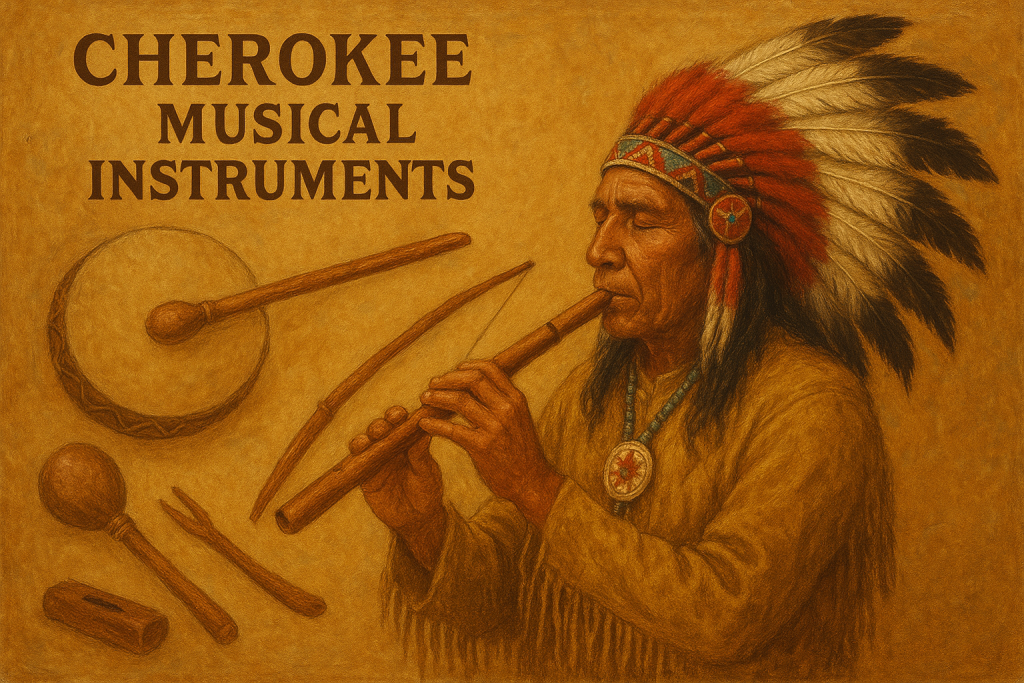
The Cherokee musical tradition features a diverse array of Cherokee musical instruments, each crafted with deep spiritual significance and practical purpose.
Traditional Cherokee ceremonial instruments were constructed entirely from natural materials found in the Cherokee homeland, reflecting their profound connection to the environment and their sophisticated understanding of acoustic properties.
The Cherokee flute, often carved from river cane or hardwood, holds particular importance in Cherokee culture. These instruments served multiple purposes: courtship rituals, personal meditation, and ceremonial accompaniment.
Cherokee flute music carries haunting melodies that mirror the natural sounds of wind through mountain valleys, creating an auditory bridge between the human and natural worlds.
The construction of these flutes required specialized knowledge passed down through generations, with each instrument uniquely tuned to its maker’s spiritual vision.
Cherokee drums, traditionally crafted from hollowed gourds or wooden frames covered with deer hide, provide the rhythmic foundation for most Cherokee ceremonial music.
The drum represents the heartbeat of Mother Earth in Cherokee cosmology, and its steady pulse during ceremonies helps participants achieve spiritual synchronization with natural rhythms.
Various sizes of drums produce different tonal qualities, from the deep, resonant bass drums used in stomp dances to smaller hand drums employed in healing ceremonies.
Rattles and shakers, constructed from gourds filled with pebbles, corn kernels, or small stones, add percussive complexity to Cherokee music.
These Cherokee ceremonial instruments often feature intricate decorative elements that hold symbolic meaning, transforming functional musical tools into sacred objects.
The river cane trumpet, carved from the abundant river cane found in Cherokee territory, produces haunting calls used for long-distance communication and ceremonial announcements.
Following European contact, Cherokee communities gradually incorporated Western instruments into their musical traditions.
The fiddle, guitar, and mandolin became popular additions, particularly in secular contexts. However, these modern instruments complemented rather than replaced traditional Cherokee instruments, creating a hybrid musical tradition that maintains cultural authenticity while embracing useful innovations. This adaptability demonstrates the Cherokee people’s pragmatic approach to cultural preservation.
Vocals and Lyrics in Cherokee Music
Cherokee vocals represent perhaps the most distinctive element of Cherokee traditional music, characterized by unique vocal techniques, complex call-and-response patterns, and the profound spiritual significance of the Cherokee language itself.
The vocal tradition encompasses everything from solo meditation chants to community-wide ceremonial singing, each style serving specific cultural and spiritual functions within Cherokee society.
The Cherokee language, with its complex tonal qualities and rich vocabulary for spiritual concepts, provides an ideal vehicle for musical expression.
Cherokee ceremonial lyrics often incorporate what practitioners call “spirit language”—sacred syllables and phrases that transcend ordinary communication to facilitate connection with spiritual realms.
These specialized vocal techniques require years of training to master, as they involve not only linguistic knowledge but also deep understanding of Cherokee spiritual practices and ceremonial protocols.
Call-and-response patterns form the backbone of many Cherokee tribal songs, creating dynamic musical conversations between lead singers and community participants.
These patterns serve both musical and social functions, allowing community members of varying skill levels to participate meaningfully in ceremonial music while ensuring proper ceremonial protocols are maintained.
The lead singer, typically an elder with extensive knowledge of traditional songs, guides the community through complex musical narratives that can last for hours during major ceremonies.
Cherokee healing chants represent one of the most specialized forms of vocal music, requiring practitioners to memorize intricate formulaic songs that address specific ailments or spiritual imbalances.
These chants combine Cherokee language with precise vocal techniques designed to channel healing energy, demonstrating the sophisticated understanding Cherokee practitioners possess regarding the therapeutic power of sound and vibration.
The preservation of these healing chants requires not only musical skill but also deep knowledge of Cherokee medical traditions and spiritual practices.
The oral tradition governing Cherokee vocals ensures that each generation receives authentic transmission of musical knowledge, though this system also allows for natural evolution and regional variation.
Contemporary Cherokee singers continue this tradition while adapting to modern contexts, maintaining the essential spiritual and cultural elements while making Cherokee music accessible to new generations of practitioners and respectful observers.
Ceremonial and Social Music
Cherokee ceremonial and social music forms the heartbeat of Cherokee community life, with distinct musical traditions accompanying every significant spiritual, social, and seasonal event.
These musical practices create sacred space, facilitate community bonding, and maintain essential connections between Cherokee people and their spiritual traditions.
The Cherokee Stomp Dance stands as perhaps the most recognizable and spiritually significant Cherokee musical tradition.
This ancient ceremony combines music, dance, and community participation in a powerful expression of Cherokee spirituality and social cohesion.
Cherokee stomp dance music features complex rhythmic patterns created by turtle shell shakers worn by female dancers, accompanied by men’s vocals that tell sacred stories and invoke spiritual blessings.
The circular movement of dancers around the sacred fire creates a meditative rhythm that can continue throughout the night, fostering deep spiritual connection and community unity.
Ball Dance Songs represent another crucial category of Cherokee ceremonial music, traditionally performed before stickball games to invoke spiritual protection and success for participants.
These Cherokee ball dance songs combine athletic preparation with spiritual ceremony, recognizing the sacred nature of competition and the need for divine blessing in all human endeavors.
The rhythmic intensity of ball dance music mirrors the physical energy required for stickball, creating psychological and spiritual preparation for this ancient Cherokee sport.
Cherokee healing chants constitute a specialized category of ceremonial music requiring extensive training and spiritual authorization to perform correctly.
These sacred songs combine precise vocal techniques with specific herbal medicines and ceremonial protocols to address physical, emotional, and spiritual ailments.
The effectiveness of healing chants depends not only on musical accuracy but also on the practitioner’s spiritual development and deep understanding of Cherokee medical traditions.
Seasonal ceremonies throughout the Cherokee year feature specific musical traditions that honor natural cycles and maintain harmony between human communities and the natural world.
Harvest songs celebrate agricultural abundance while expressing gratitude to the Creator for sustaining life.
Life transition ceremonies—including naming ceremonies, coming-of-age rituals, and funeral rites—feature specialized music that helps participants navigate significant life changes while maintaining connection to Cherokee cultural values and spiritual beliefs.
Evolution & Influences on Cherokee Music
The evolution of Cherokee music reflects the complex history of Cherokee people’s interactions with other cultures while maintaining essential elements of their traditional musical heritage.
This musical evolution demonstrates remarkable adaptability without compromising core spiritual and cultural values that define authentic Cherokee musical expression.
European contact in the 16th and 17th centuries introduced Cherokee communities to new musical instruments and compositional styles that gradually became integrated into Cherokee musical traditions.
Scottish and Irish fiddle traditions, brought by traders and settlers, particularly influenced Cherokee secular music, creating hybrid styles that maintained Cherokee melodic sensibilities while incorporating Celtic rhythmic patterns and instrumental techniques.
This cross-cultural musical exchange produced unique regional variations that enriched Cherokee musical traditions without displacing traditional ceremonial practices.
Christian missionary influence in the 18th and 19th centuries led to the development of a distinctive Cherokee hymn tradition that demonstrates remarkable cultural synthesis.
Cherokee translators adapted Christian hymns into the Cherokee language using traditional Cherokee melodic patterns and vocal techniques, creating a hybrid musical form that satisfied missionary requirements while preserving essential Cherokee musical characteristics.
The Cherokee syllabary, developed by Sequoyah in the early 19th century, facilitated the written preservation of these hymns while maintaining the oral tradition that governed traditional Cherokee music.
African musical influences, introduced through contact with enslaved and free African Americans, contributed rhythmic complexity and call-and-response techniques that complemented existing Cherokee musical practices.
These influences particularly enriched Cherokee secular music and contributed to the development of unique Cherokee blues and folk traditions that emerged in the late 19th and early 20th centuries.
The forced removal period and subsequent diaspora of Cherokee communities created new challenges and opportunities for musical evolution.
Cherokee people scattered across different geographic regions encountered diverse musical traditions while working to maintain cultural connections to their homeland and traditional practices.
This dispersal led to regional variations in Cherokee music while strengthening the role of music as a marker of Cherokee identity and cultural continuity.
Contemporary Cherokee music continues this evolutionary process, incorporating modern instruments and recording technologies while preserving traditional spiritual and cultural functions.
Cherokee tribal governments actively support musical preservation and education programs that ensure young Cherokee people receive authentic musical training while encouraging creative adaptation to contemporary contexts.
Notable Cherokee Musicians and Elders
Cherokee musical traditions have been preserved and transmitted through the dedicated work of numerous influential musicians, elders, and cultural practitioners who have served as bridges between ancient traditions and contemporary practice.
These remarkable individuals have ensured that Cherokee music continues to thrive as a living tradition rather than a historical artifact.
Walker Calhoun stands as perhaps the most recognized Cherokee traditional music teacher of the modern era, receiving the National Heritage Fellowship for his lifetime dedication to preserving and teaching Cherokee musical traditions.
Born on the Qualla Boundary in North Carolina, Calhoun spent decades learning traditional songs from Cherokee elders before becoming a master teacher himself.
His work encompassed not only musical instruction but also the transmission of cultural knowledge essential for understanding the spiritual and social contexts that give Cherokee music its authentic meaning.
Calhoun’s teaching methods emphasized experiential learning within ceremonial contexts, ensuring that students understood Cherokee music as an integral part of Cherokee spiritual and social life rather than mere performance art.
Will West Long, a prominent Cherokee medicine man and scholar, played a crucial role in preserving Cherokee ceremonial music during the early 20th century when many traditional practices faced extinction due to government suppression and cultural assimilation pressures.
Long worked extensively with anthropologists and linguists to document Cherokee songs, stories, and ceremonial practices while maintaining his role as an active ceremonial leader within Cherokee communities.
His dual role as cultural insider and academic collaborator helped ensure that Cherokee musical knowledge was preserved accurately while remaining accessible to Cherokee communities.
The Warriors of AniKituhwa represent a contemporary group of Cherokee tradition-bearers who have dedicated themselves to maintaining and revitalizing Cherokee musical and dance traditions.
This organization combines master traditional musicians with younger practitioners, creating intergenerational learning opportunities that ensure cultural continuity while allowing for natural evolution of Cherokee musical practices.
Their public performances and educational programs have introduced Cherokee music to broader audiences while maintaining strict adherence to cultural protocols and spiritual significance.
Louis W. Ballard, of Quapaw and Cherokee heritage, earned recognition as the “father of Native American classical music” for his groundbreaking work in creating orchestral compositions that incorporated Native American musical elements into Western classical forms.
His innovative approach demonstrated how traditional Native American music could engage with contemporary musical contexts while maintaining cultural authenticity and spiritual significance.
Cultural Meaning and Preservation Today
Cherokee music today serves multiple interconnected functions within Cherokee communities while facing both opportunities and challenges in an increasingly globalized world.
The cultural meaning of Cherokee traditional music extends far beyond artistic expression, encompassing spiritual practice, cultural education, community building, and identity preservation for Cherokee people across different geographic regions and social contexts.
The connection between Cherokee music, storytelling, and communal identity remains as strong today as in ancient times, though it now operates within complex contemporary social environments.
Cherokee families continue to use traditional songs to teach children about Cherokee history, values, and spiritual beliefs, while Cherokee educational institutions incorporate musical instruction into broader cultural education programs.
This integration of music into daily life ensures that Cherokee musical traditions continue to serve their traditional function of cultural transmission while adapting to modern educational methods and social structures.
Contemporary preservation efforts face significant challenges related to maintaining authenticity while accommodating necessary adaptations to modern contexts.
The oral tradition that governs Cherokee music transmission creates both strengths and vulnerabilities in preservation efforts.
While oral transmission ensures that Cherokee music remains a living tradition responsive to community needs, it also makes Cherokee musical knowledge vulnerable to loss when master practitioners die without having fully transmitted their knowledge to younger generations.
Cherokee tribal governments—including the Cherokee Nation, Eastern Band of Cherokee Indians, and United Keetoowah Band—have implemented comprehensive cultural preservation programs that prioritize musical education and transmission.
These programs combine traditional apprenticeship methods with modern educational technologies to reach Cherokee youth who may live far from traditional Cherokee communities.
Language preservation efforts particularly support musical preservation, as Cherokee songs lose much of their spiritual power and cultural meaning when translated into English.
The influence of pan-Indian movements and intertribal powwow culture presents both opportunities and challenges for Cherokee musical preservation.
While these broader Native American cultural movements provide platforms for Cherokee musicians to share their traditions with wider audiences, they also create pressure to adapt Cherokee music to fit non-Cherokee performance contexts and audience expectations.
Cherokee cultural practitioners work carefully to distinguish between appropriate cultural sharing and inappropriate cultural commodification.
Modern practices incorporating Cherokee music include public educational performances, ceremonial gatherings, academic research collaborations, and digital preservation projects that ensure Cherokee musical knowledge remains accessible to future generations while respecting cultural protocols governing sacred material.
Closing Thoughts
The enduring role of Cherokee music in spiritual, social, and artistic life demonstrates the remarkable resilience and adaptability of Cherokee culture in the face of historical challenges and contemporary changes.
Cherokee musical traditions continue to evolve while maintaining their essential spiritual and cultural functions, serving as powerful expressions of Cherokee identity and vehicles for cultural transmission that connect past, present, and future generations of Cherokee people.
Cherokee music offers profound insights into the sophisticated spiritual and artistic traditions that characterize Cherokee culture, revealing how music can serve simultaneously as entertainment, education, healing practice, and spiritual communion.
The complex relationships between Cherokee music and Cherokee language, spirituality, social structure, and connection to the natural world demonstrate the holistic nature of Cherokee cultural traditions and their continued relevance in contemporary contexts.
For those interested in exploring authentic Cherokee music, it is essential to approach these traditions with respect for their spiritual significance and cultural protocols.
Cherokee music is not merely performance art but sacred practice that requires appropriate context and understanding to appreciate fully.
Interested individuals should seek out educational opportunities provided by Cherokee cultural organizations and institutions that emphasize respectful engagement with Cherokee musical traditions.
The preservation of Cherokee music depends on continued support for Cherokee cultural practitioners, Cherokee language preservation efforts, and Cherokee educational institutions that provide authentic cultural instruction.
By supporting these preservation efforts, both Cherokee and non-Cherokee people can help ensure that these remarkable musical traditions continue to enrich human culture while serving their essential functions within Cherokee communities.
FAQ Section
What instruments are traditional in Cherokee Native American music?
Traditional Cherokee musical instruments include the river cane flute, various drums made from gourds or wooden frames, rattles and shakers constructed from gourds filled with natural materials, whistles carved from wood or bone, and river cane trumpets.
These Cherokee ceremonial instruments were crafted entirely from natural materials found in Cherokee territory.
Following European contact, Cherokee musicians also incorporated fiddles, guitars, and mandolins into their musical traditions while maintaining the use of traditional instruments for ceremonial purposes.
What is the Cherokee Stomp Dance?
The Cherokee Stomp Dance is a sacred ceremonial dance and musical tradition that combines community singing, rhythmic movement around a sacred fire, and the distinctive sound of turtle shell shakers worn by female dancers.
This ancient ceremony serves multiple spiritual and social functions, including community bonding, spiritual communion, and the preservation of Cherokee cultural traditions.
Cherokee stomp dance music features complex call-and-response patterns between lead singers and community participants, creating an immersive ceremonial experience that can continue throughout the night.
How has outside influence changed Cherokee music?
Cherokee music has evolved through contact with European, African, and Christian musical traditions while maintaining its essential spiritual and cultural characteristics.
European instruments like fiddles and guitars were integrated into Cherokee musical practices, particularly in secular contexts.
Christian missionary influence led to the development of a distinctive Cherokee hymn tradition that combined Cherokee language and melodic patterns with Christian themes.
African musical influences contributed rhythmic complexity and enhanced call-and-response techniques.
Despite these influences, Cherokee ceremonial music has preserved its traditional forms and spiritual functions.
Who are notable Cherokee tradition-bearers?
Notable Cherokee musicians and tradition-bearers include Walker Calhoun, who received the National Heritage Fellowship for his work preserving and teaching Cherokee traditional music; Will West Long, a medicine man and scholar who documented Cherokee ceremonial practices; the Warriors of AniKituhwa, contemporary tradition-bearers maintaining Cherokee musical and dance traditions; and Louis W. Ballard, known as the “father of Native American classical music” for his innovative orchestral compositions incorporating Native American musical elements.
Where can I hear authentic Cherokee Native American music?
Authentic Cherokee music can be experienced through Cherokee cultural centers, tribal gatherings, educational programs offered by Cherokee institutions, and performances by recognized Cherokee cultural practitioners.
The Cherokee Nation, Eastern Band of Cherokee Indians, and United Keetoowah Band all provide cultural programs that include traditional music.
It’s important to seek out performances that emphasize cultural education and respect for Cherokee traditions rather than commercial entertainment that may misrepresent Cherokee musical practices.
Source: Cherokee Music Instruments
Related Post: The Grass Dance of Native America


