
Learning the Navajo language, known as Diné Bizaad (“the people’s language”), opens a window into one of North America’s most complex and beautiful linguistic traditions.
With approximately 170,000 speakers, Navajo represents the most widely spoken indigenous language in the United States, yet it faces ongoing challenges that make language learning and preservation efforts more crucial than ever.
This comprehensive guide presents 100 of the most commonly used Navajo words, carefully organized by themes to provide practical vocabulary for beginning learners while honoring the cultural richness and linguistic sophistication of this ancient language.
Whether you’re a student seeking to connect with Navajo heritage, an educator developing curriculum materials, or simply someone fascinated by linguistic diversity, these essential words provide a foundation for understanding and appreciating Diné Bizaad.
The Navajo language belongs to the Athabaskan family and features complex grammatical structures, tonal patterns, and unique sounds that make it both challenging and rewarding to learn.
Each word in this collection represents not just vocabulary but cultural knowledge, traditional understanding, and connections to the land and relationships that have shaped Navajo life for centuries.
Understanding these 100 common Navajo words requires appreciating their cultural contexts and proper pronunciation, as the language’s tonal nature means that pitch changes can alter meanings entirely.
We encourage learners to seek audio resources and native speaker guidance to master the pronunciation and cultural protocols that ensure respectful engagement with this sacred language.
This vocabulary collection supports ongoing efforts to preserve and revitalize Navajo language by providing accessible learning materials while emphasizing the importance of cultural respect and community support in language learning endeavors.
Essential Greetings and Polite Expressions
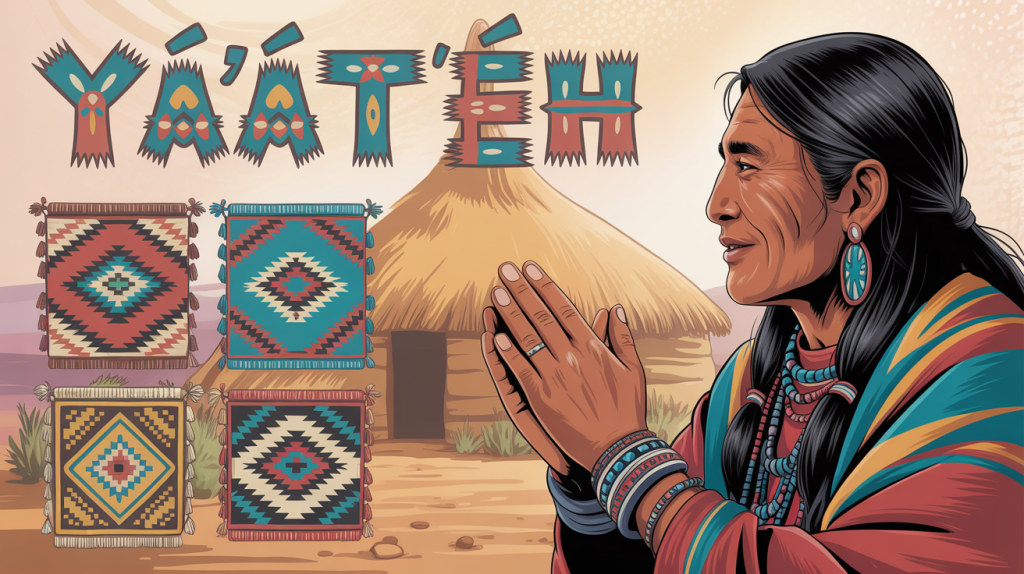
Mastering basic Navajo greetings provides the foundation for respectful communication and demonstrates appreciation for Navajo cultural values. These expressions often carry deeper meanings than their English translations suggest.
Yá’át’ééh (ya-ah-tay) serves as the most important greeting, meaning “it is good” and expressing wishes for well-being and harmony.
This greeting reflects the cultural importance of Hózhǫ́ (harmony/beauty) and can be used at any time of day.
Ahéhee’ (ah-hay-hay) expresses gratitude and appreciation, used in contexts ranging from simple thanks to deep gratitude for significant help or kindness. The expression connects to cultural values about reciprocity and acknowledgment.
Aoo’ (ah-oh) means “yes” and represents affirmative response, while Dooda (doh-dah) means “no” and provides negative response. These basic affirmatives are essential for any conversation.
Doolee’ (doh-lay) serves as “please” and reflects cultural patterns of polite request-making that emphasize respect for others’ autonomy and willingness to help.
Yá’át’ééh abíní (ya-ah-tay ah-bee-nee) means “good morning,” literally “it is good, the day,” connecting greetings to natural cycles and the blessing of each new day.
Tł’éé’ honáágoo (tlay ho-nah-go) means “good evening,” acknowledging the transition from day to night and wishing well-being during evening hours.
Hágoónee’ (ha-go-nay) serves as “goodbye,” expressing wishes for continued well-being and safe journeys until the next meeting.
Shí yá’át’éeh (shee ya-ah-tay) means “excuse me,” providing polite ways to get attention or apologize for minor disruptions.
Shí éí… (shee ay-ee) begins the phrase “my name is…” allowing for personal introductions that establish identity and relationships.
These greetings establish proper social relationships and demonstrate respect for Navajo cultural values about harmony, reciprocity, and community connection.
Family and Relationships: The Heart of Navajo Culture

Family terms in Navajo reflect the complex kinship system and matrilineal social organization that forms the foundation of traditional Navajo society. Understanding these relationships requires appreciating both biological and clan-based family structures.
Shimá (shi-mah) means “my mother,” with the possessive prefix “shi-” indicating first person possession. Mothers hold central positions in matrilineal Navajo society, with children belonging to their mother’s clan.
Shizhé’é (shi-zhay-ay) means “my father,” reflecting the important but different role that fathers play in Navajo family structure, often representing connections to father’s clan relationships.
Shimasání (shi-mah-sah-nee) means “my grandmother,” with different terms used for maternal versus paternal grandmothers reflecting the kinship system’s complexity. Grandmothers traditionally hold important roles in cultural education.
Shicheii (shi-chay-ee) means “my grandfather,” with similar distinctions for different types of grandfathers based on clan relationships and family structure. Grandfathers often serve as cultural teachers.
Hastíín (has-teen) means “man” or “adult male,” representing mature masculine identity within traditional Navajo understanding of gender roles and social responsibilities.
Asdzą́ą́ (as-dzah) means “woman” or “adult female,” reflecting mature feminine identity and the important roles that women play in traditional Navajo society.
Ashkii (ash-kee) means “boy” or “young male,” indicating male children and youth who are learning traditional roles and responsibilities within their families and communities.
At’ééd (ah-tay-ed) means “girl” or “young female,” representing female children and youth who are being prepared for their future roles as women within Navajo society.
Awéé’ (ah-way-ay) means “child” or “baby,” referring to young children regardless of gender and reflecting the special care and attention given to the youngest community members.
Shiyáázh (shi-yahzh) means “my son,” indicating the relationship between parents and male children, with specific cultural expectations and responsibilities attached to this relationship.
Shibizh (shi-bizh) means “my daughter,” reflecting the relationship between parents and female children, with particular emphasis on the transmission of cultural knowledge through maternal lines.
K’é (kay) represents the broad concept of kinship and family relationships that extends beyond biological connections to include clan relationships, adopted family, and community bonds.
Sikis (si-kis) means “my friend,” representing non-family relationships that involve mutual respect and support, reflecting cultural values about reciprocity and social responsibility.
Daily Life and Common Objects in Navajo

Vocabulary for daily life and common objects provides practical language for describing immediate surroundings and basic needs, reflecting traditional Navajo life while adapting to contemporary circumstances.
Hooghan (ho-gahn) means “house” or “hogan,” referring to traditional Navajo dwellings and by extension any home or residence. The hogan carries deep spiritual significance as a sacred space.
Ch’iyáán (ch-ee-yahn) means “food,” representing sustenance and the cultural practices surrounding eating, sharing meals, and providing nourishment for family and community members.
Tó (toh) means “water,” one of the most essential elements for life and holding special significance in traditional Navajo spirituality and daily survival in arid environments.
Dibé (dee-bay) means “sheep,” representing animals that became central to Navajo economy and culture after their introduction by Spanish colonizers, providing wool, meat, and wealth.
Łééchąą’í (lay-chah-ee) means “dog,” referring to domestic animals that served as companions, guards, and helpers in traditional Navajo life.
Mósí (mo-see) means “cat,” representing domestic animals that became part of Navajo households, though less central to traditional culture than dogs or sheep.
Łį́į́’ (lee) means “horse,” representing animals that revolutionized Navajo culture by providing mobility, military capability, and prestige within traditional society.
Béésh (baysh) means “knife” or “metal,” representing essential tools for daily work and the broader category of metal objects that became important in traditional life.
Tł’ish (tlish) means “snake,” representing both literal snakes found in the environment and their cultural significance in traditional stories and spiritual understanding.
These everyday terms provide the foundation for discussing immediate needs, describing environments, and engaging in practical communication about daily life activities and concerns.
Nature and Environment in Navajo Language
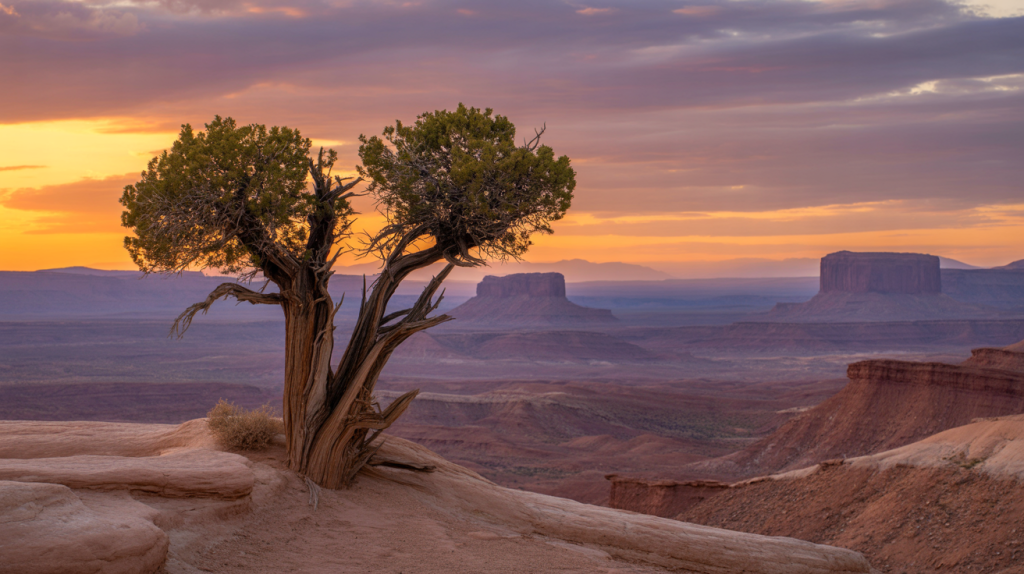
Navajo vocabulary for nature reflects deep spiritual relationships with the environment and traditional ecological knowledge that sustained communities for centuries within challenging Southwestern landscapes.
Nahasdzáán (nah-has-dzahn) means “earth” or “ground,” representing not just physical soil but the sacred relationship between Navajo people and Mother Earth, fundamental to traditional spirituality.
Sháńdíín (shahn-deen) means “sun,” representing the daily blessing of light and warmth, along with spiritual significance as a source of life and energy honored in traditional ceremonies.
Tł’éé’shí (tlay-shee) means “moon,” representing the celestial body that governs night and monthly cycles, important for traditional timekeeping and ceremonial scheduling.
Yádiłhił (yah-dee-hill) means “sky,” representing the vast expanse above that connects earth to spiritual realms and serves as home for various sacred beings and forces.
Dził (dzill) means “mountain,” representing the sacred peaks that define Navajo homeland and serve as dwelling places for Holy People, crucial for spiritual orientation and identity.
Tsé (tsay) means “rock” or “stone,” representing both practical materials for tools and construction and spiritual entities that hold power and significance in traditional understanding.
Tsin (tsin) means “tree” or “wood,” representing living beings that provide materials for construction, tools, and fuel while serving as homes for various animals and spiritual entities.
Ch’il (ch-eel) means “plant” or “vegetation,” representing the green growing things that provide food, medicine, and materials while contributing to the beauty and health of the landscape.
Níłch’i (nee-ch-ee) means “wind,” representing the moving air that brings life, carries prayers, and connects all beings through the breath that sustains existence.
Níłtsą́ (nee-tsah) means “rain,” representing the precious water that falls from sky to nourish all life, celebrated in traditional ceremonies and essential for survival in arid regions.
Yas (yahs) means “snow,” representing winter precipitation that provides stored water for spring growth while creating beautiful but challenging conditions for traditional life.
Kǫ’ (ko) means “fire,” representing the element that provides warmth, light, cooking capability, and spiritual focus, central to traditional ceremonies and daily survival.
Tł’éé’ (tlay) means “night,” representing the daily period of darkness when different activities occur and spiritual forces may be more active or accessible.
Abíní (ah-bee-nee) means “day,” representing the daily period of light when most activities traditionally occurred and the blessing of each new opportunity for life and work.
Numbers in Navajo: Counting in Diné Bizaad
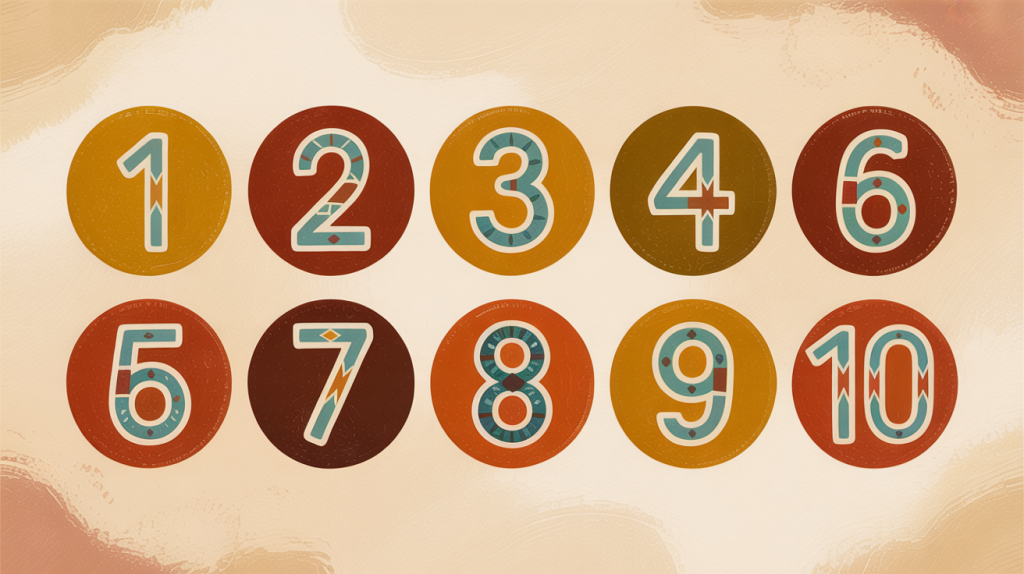
The Navajo number system reflects traditional counting methods and provides essential vocabulary for quantities, ages, and mathematical concepts necessary for daily communication and learning.
T’ááłáhí (tah-ah-lah-hee) means “one,” representing the beginning of counting and the concept of individual units, fundamental for all mathematical concepts and quantity discussions.
Naaki (nah-kee) means “two,” representing pairs and duality, important concepts in traditional Navajo understanding of balance and relationships between complementary forces.
Táá’ (tah) means “three,” continuing the counting sequence while also representing concepts of completeness that appear in various cultural and spiritual contexts.
Dį́į́’ (dee) means “four,” representing a particularly significant number in Navajo culture, related to the four directions, four sacred mountains, and four-part ceremonial structures.
Ashdla’ (ash-dlah) means “five,” representing the number of fingers on one hand and traditional base-five counting systems that appear in various cultural practices.
Hastą́ą́ (has-tah) means “six,” continuing the counting sequence and representing quantities beyond basic finger counting that require more sophisticated numerical understanding.
Tsosts’id (tso-tseed) means “seven,” representing larger quantities while maintaining the phonetic patterns and grammatical structures characteristic of Navajo number words.
Tseebíí (tsay-bee) means “eight,” approaching the completion of the first ten numbers and representing quantities that require systematic counting approaches.
Náhást’éí (nah-has-tay-ee) means “nine,” representing the final single digit in base-ten counting while maintaining distinctive Navajo phonetic characteristics.
Neezná (nay-znah) means “ten,” representing the completion of basic counting and the foundation for larger numbers, traditionally associated with finger and toe counting systems.
These numbers provide the foundation for discussing quantities, ages, times, distances, and mathematical concepts necessary for both traditional and contemporary life.
Colors in Navajo: The Rainbow of Navajo Expression

Color terms in Navajo often reflect natural phenomena and traditional dye sources while carrying cultural and spiritual significance that extends beyond simple visual description.
Łichíí’ (lee-chee) means “red,” representing the color of blood, fire, sunset, and various traditional materials, often associated with strength, life force, and spiritual power.
Dootł’izh (doh-tlizh) means “blue,” representing the color of sky, water, turquoise, and various natural elements, often associated with healing, protection, and spiritual significance.
Táchii’ (tah-chee) means “green,” representing the color of growing plants, spring vegetation, and various natural materials, associated with growth, renewal, and natural abundance.
Łizhin (lee-zhin) means “black,” representing the color of night, shadows, certain animals, and various natural materials, often associated with protection, mystery, and spiritual depth.
Łigai (lee-guy) means “white,” representing the color of snow, clouds, certain animals, and various natural materials, often associated with purity, peace, and spiritual cleansing.
Łitso (lee-tso) means “yellow,” representing the color of sun, corn, certain flowers, and various natural materials, often associated with blessing, prosperity, and spiritual illumination.
These color terms provide vocabulary for describing the visual world while carrying cultural meanings that connect physical appearance to spiritual understanding and traditional knowledge.
Essential Verbs in navajo: Actions and States
Navajo verbs represent one of the most complex aspects of the language, with elaborate systems for encoding information about aspect, mode, person, and other grammatical categories.
Yá (yah) means “go,” representing movement away from the speaker and one of the most essential verbs for describing travel, journeys, and various types of departure.
Níyá (nee-yah) means “come,” representing movement toward the speaker and providing the complement to “go” for describing all basic movement patterns.
Séda (say-dah) means “sit,” representing the action of being seated and the state of remaining in one place, important for describing positions and activities.
Naasháa’ (nah-shah) means “walk,” representing basic human locomotion and the most common way of moving from place to place in traditional contexts.
Yishááł (yee-shaahl) means “run,” representing faster movement used for hunting, games, ceremonies, and various activities requiring speed and endurance.
Ch’iyáán yishdlá (ch-ee-yahn yish-dlah) means “eat,” representing the consumption of food and the cultural practices surrounding meals, sharing, and nourishment.
Yishdlą́ (yish-dlah) means “drink,” representing the consumption of liquids and the essential activity of maintaining hydration and health.
Yishtł’ish (yish-tlish) means “sleep,” representing the daily period of rest and the cultural practices surrounding bedtime, dreams, and renewal.
Yáshti’ (yash-tee) means “talk” or “speak,” representing verbal communication and the cultural practices surrounding conversation, storytelling, and information sharing.
These basic verbs provide the foundation for describing actions, states, and activities necessary for daily communication and interaction.
Descriptive Words in Navajo: Qualities and Characteristics

Descriptive vocabulary allows for expressing qualities, characteristics, and evaluations that make communication more precise and culturally appropriate.
Nizhóní (nee-zhoh-nee) means “beautiful” or “pretty,” representing aesthetic appreciation and the cultural value placed on beauty in all aspects of life and experience.
Nitsaa (nee-tsah) means “big” or “large,” providing vocabulary for describing size and scale, important for practical communication about objects, distances, and quantities.
Yázhí (yah-zhee) means “small” or “little,” offering the complement to “big” while also serving as an affectionate term for children and beloved objects.
Sání (sah-nee) means “old,” describing both advanced age and the respect accorded to elders who carry traditional knowledge and cultural wisdom.
Łikan (lee-kahn) means “young,” describing youth and the potential for growth, learning, and development that characterizes early life stages.
Ayóó yá’át’ééh (ah-yoh yah-ah-tay) means “very good” or “happy,” expressing positive evaluation and emotional states associated with well-being and satisfaction.
These descriptive terms enable more nuanced communication while reflecting cultural values about beauty, respect, and proper evaluation of people, objects, and experiences.
Animals and Living Beings in Navajo
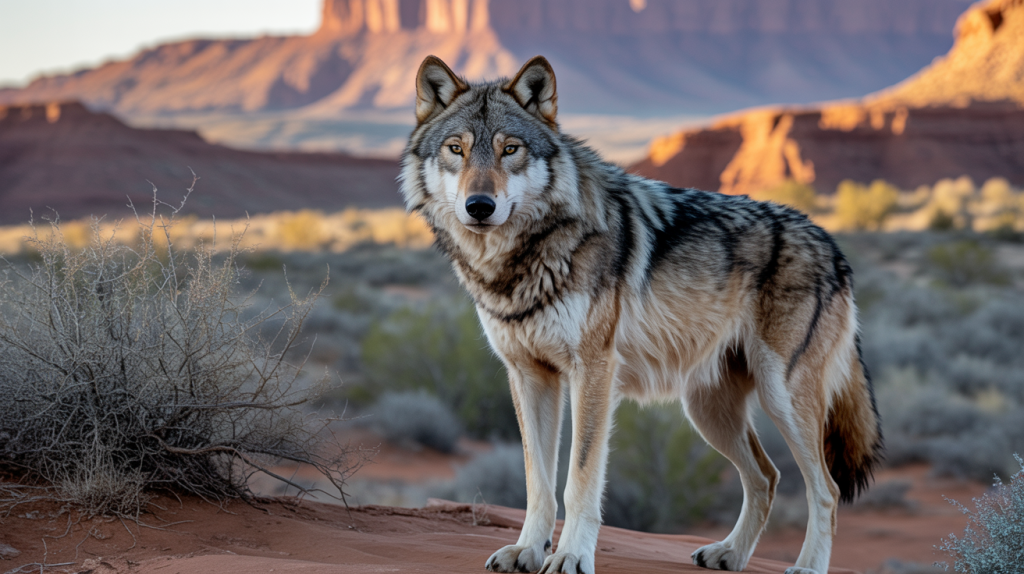
Animal vocabulary reflects traditional ecological knowledge and the relationships between Navajo people and the diverse wildlife of the Southwestern environment.
Mą’ii (mah-ee) means “coyote,” representing an animal that features prominently in traditional stories as a trickster figure and cultural teacher, both respected and watched carefully.
Ma’iitsoh (mah-ee-tsoh) means “wolf,” representing a powerful predator that holds spiritual significance and appears in traditional stories and ceremonies as a symbol of strength and wisdom.
Gah (gah) means “rabbit,” representing small game animals that provided food and fur while also appearing in traditional stories as examples of cleverness and survival skills.
Tł’izh (tlizh) means “deer,” representing important game animals that provided meat, hides, and other materials essential for traditional survival while holding spiritual significance.
Tsídii (tsee-dee) means “bird,” representing the flying creatures that connect earth and sky while providing examples of freedom, beauty, and spiritual messengers.
Lóó’ (loh) means “fish,” representing aquatic creatures found in traditional waters and providing both food sources and examples of adaptation to different environments.
Ch’osh (ch-osh) means “bug” or “insect,” representing the small creatures that play important roles in ecosystems while sometimes presenting challenges for human activities.
These animal terms provide vocabulary for discussing the natural world while carrying cultural knowledge about traditional relationships between humans and other living beings.
Practical Usage and Learning Tips
Successfully learning these 100 common Navajo words requires understanding pronunciation patterns, cultural contexts, and proper usage protocols that ensure respectful and effective communication.
Pronunciation Guidelines emphasize the importance of tonal accuracy, as Navajo uses pitch changes to distinguish word meanings. High tones are marked with acute accents, while low tones remain unmarked.
Cultural Context matters significantly in Navajo communication, with many words carrying spiritual or social significance that affects when and how they should be used appropriately.
Practice Strategies should include listening to native speakers, repetitive pronunciation exercises, and gradual integration of words into meaningful phrases and conversations.
Learning Resources available online and through Native American cultural organizations provide audio examples, expanded vocabulary lists, and cultural education that supports respectful language learning.
Community Connections with Navajo speakers and cultural practitioners offer the best opportunities for authentic learning while building relationships that support ongoing cultural exchange and understanding.
Expanding Your Navajo Vocabulary
These 100 common words provide a foundation for further language learning that can lead to more sophisticated communication and deeper cultural understanding through continued study and practice.
Thematic Expansion involves learning additional words within each category presented here, building vocabulary clusters that support specific types of communication and cultural knowledge.
Grammar Integration requires understanding how these words function within Navajo sentence structures and the complex verb systems that characterize this sophisticated language.
Cultural Learning should accompany vocabulary development, as understanding Navajo culture enhances language comprehension while demonstrating proper respect for the traditions from which the language emerges.
Immersion Opportunities through cultural events, educational programs, and community connections provide authentic contexts for practicing vocabulary while building cultural competence.
Advanced Studies might include formal language courses, linguistic analysis, and participation in language revitalization efforts that support the continued vitality of Diné Bizaad.
Frequently Asked Questions About Navajo Vocabulary
How difficult is it to pronounce Navajo words correctly?
Navajo pronunciation requires mastering several sounds that don’t exist in English, including ejective consonants, various fricatives, and the tonal patterns that distinguish word meanings.
The ejective consonants, marked with apostrophes, require sharp releases of air that can be challenging for English speakers to master.
The tonal system adds another layer of complexity, as high and low tones must be accurate for words to be understood correctly.
Many learners find that consistent practice with audio resources and native speaker feedback helps develop the ear training necessary for accurate pronunciation.
Vowel length distinctions also affect meaning, with short and long vowels creating different words. Long vowels are marked with acute accents and must be held approximately twice as long as short vowels for accurate pronunciation.
The key to successful pronunciation is patience, regular practice, and acceptance that achieving native-like accuracy requires time and dedication.
Many learners find success by focusing on one sound at a time while gradually building their pronunciation skills.
What’s the best way to memorize these vocabulary words?
Effective memorization strategies for Navajo vocabulary combine visual, auditory, and kinesthetic learning approaches while incorporating cultural context that makes words more meaningful and memorable.
Flashcard systems work well when they include both written words and audio pronunciation, allowing learners to practice recognition and production simultaneously. Digital flashcard apps can provide spaced repetition that optimizes review timing.
Thematic grouping helps create mental connections between related words, making it easier to recall vocabulary within specific contexts like family relationships, daily activities, or natural phenomena.
Cultural storytelling provides meaningful contexts for vocabulary use, helping learners understand how words function in authentic communication while learning about Navajo traditions and values.
Regular practice with native speakers or audio resources ensures that pronunciation remains accurate while building confidence in actual communication situations.
Can learning these words help with Navajo grammar?
While vocabulary provides essential building blocks, understanding Navajo grammar requires additional study of the complex verb systems, sentence structures, and grammatical patterns that characterize this sophisticated language.
However, learning common words does provide exposure to typical Navajo sound patterns, prefix systems, and morphological structures that form the foundation for more advanced grammar study.
The possessive prefixes used with family terms (shi- for “my”) introduce learners to the concept of person marking that appears throughout Navajo grammar in various forms.
Action words in this list provide examples of verb stems that can help learners understand how Navajo verbs change based on aspect, mode, and other grammatical categories.
Building vocabulary simultaneously with basic grammar concepts creates a more comprehensive learning foundation than studying either element in isolation.
Are there regional variations in these common words?
Most of the words in this collection represent standard Navajo vocabulary that is understood throughout the Navajo Nation, though some pronunciation differences may exist between different regions or communities.
Regional variations are generally minor for basic vocabulary, with the most significant differences appearing in specialized terms, ceremonial language, or local expressions that reflect specific community experiences.
The standardization efforts that accompanied the development of Navajo writing systems have helped maintain consistency in basic vocabulary while preserving regional diversity in more specialized language use.
Learners should be aware that individual speakers may have slight pronunciation differences or preferred expressions, but the vocabulary presented here provides a solid foundation for communication across the Navajo Nation.
How can I use these words respectfully in conversation?
Respectful use of Navajo vocabulary requires understanding cultural contexts, appropriate situations for language use, and the importance of learning from and acknowledging Native speakers and communities.
Begin with basic greetings and polite expressions while focusing on accurate pronunciation and appropriate cultural contexts for their use. Many Navajo people appreciate respectful efforts to learn their language.
Avoid using Navajo words in casual or inappropriate contexts, particularly terms that may have spiritual significance or cultural protocols governing their use.
Learning vocabulary should be accompanied by learning about Navajo culture, history, and contemporary issues to ensure that language use demonstrates genuine respect and understanding.
Supporting Navajo language preservation efforts, Native artists, and cultural programs helps ensure that language learning contributes to rather than exploits indigenous cultural heritage.
Conclusion: Building Bridges Through Language
Learning these 100 common words in Navajo language represents more than vocabulary acquisition—it offers a respectful pathway toward understanding and appreciating one of North America’s most sophisticated and culturally significant indigenous languages.
Each word carries within it centuries of traditional knowledge, cultural wisdom, and the unique perspective that Diné Bizaad brings to understanding the world.
The journey of learning Navajo vocabulary connects students to the ongoing efforts of Native communities to preserve and revitalize their ancestral language while maintaining its relevance for contemporary life.
Every person who learns these words becomes part of a larger movement to ensure that Diné Bizaad continues to thrive for future generations.
Understanding these common words provides a foundation for deeper cultural learning and relationship building with Navajo communities, demonstrating respect for indigenous knowledge while supporting the educational and cultural goals that strengthen tribal sovereignty and cultural continuity.
The complexity and beauty of Navajo language, evident even in these basic vocabulary items, reminds us of the incredible diversity of human linguistic expression and the importance of preserving indigenous languages as irreplaceable repositories of cultural knowledge and human creativity.
As you continue your learning journey with Diné Bizaad, remember that language learning is most meaningful when it occurs within relationships of respect, reciprocity, and genuine appreciation for the cultures and communities that have maintained these traditions through centuries of challenge and change.
These 100 words represent just the beginning of a rich linguistic tradition that offers endless opportunities for learning, cultural exchange, and personal growth through engagement with one of the world’s most remarkable indigenous languages.
Yá’át’ééh—may your journey with the Navajo language be good and bring you into harmony with the beauty and wisdom of Diné culture.
Sources:
Navajo Code Talker Dictionary – US Navy
Diné Bizaad – Speak, Read, Write Navajo
Related Post: Navajo Language


